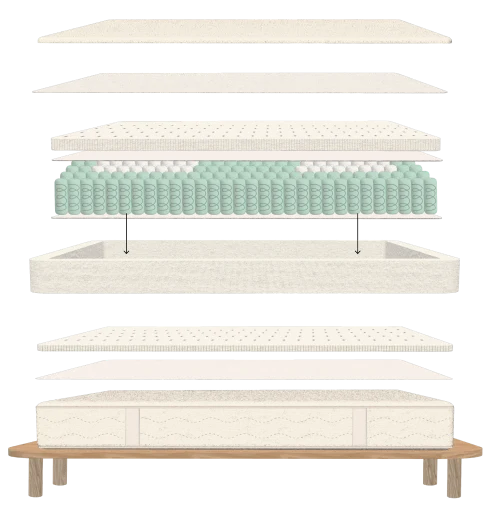
Certified organic cotton over natural latex and zoned pocket springs — the most certified mattress we cover, at a price that does not usually buy any of it.
The best-certified mattress we cover, and one of very few where natural latex sits over zoned springs at this price. What it gives up is motion isolation — if a restless partner is your main problem, look elsewhere first.
Who It’s Best For
✓ Anyone buying on materials and certification
✓ Latex sleepers who want response, not sink
✓ Allergy and chemical-sensitive households
✓ Buyers who want springs under $1,300
Not ideal for
✕ Light sleepers with a restless partner
✕ Anyone wanting a deep memory-foam sink
✕ Couples who disagree about firmness
At a Glance
Our Rating
8.7
/10
Certified Materials
9.5
Edge Support
9.0
Value
9.0
Support
8.8
Cooling
8.8
Comfort
8.5
Motion Isolation
7.5
How We Research
We do not sleep on mattresses and we do not claim to. This rating is built from verified owner reviews at scale, an independent reviewer who does test by hand, the manufacturer’s published specifications, and the fine print of the trial and warranty. Every input is named, and the score is the average of the sub-scores beside it — you can add them up.
215
Verified owner reviews analysed
4.5/5
Bedbuyer’s hands-on rating
9
Layers, from published specs
7
Sub-scores behind the total
Background
Who is Peace Lily?
Peace Lily builds around one idea, and it is an unusual one for the price bracket: every material has to be certified. The cover is certified 100% organic cotton, the materials are certified to OEKO-TEX Standard 100 Class 1, the latex is Regenagri certified, and the certifications are the product rather than a footnote on it. Bedbuyer’s own summary lands on the same point — its “high number of non-toxic certifications give this product plenty of appeal”.
That matters most to a specific buyer: someone with allergies, a chemical sensitivity, a nursery, or simply a preference for knowing what is in the thing they spend a third of their life on. Most mattresses that answer that question properly cost considerably more than this one. Peace Lily also sells toppers, pillows, sheets and protectors built to the same standard, which is rare — usually the certified brands do one product well and nothing else.
Construction
What’s inside the Peace Lily Hybrid
1
Organic cotton cover — breathable, and certified organic rather than described as natural
2
Organic cotton wadding — the soft first contact, no synthetic fill
3
5cm natural latex comfort layer — responds and lifts rather than swallowing, which is the opposite of memory foam
4
3-zone pocket springs — softer under head and feet, firmer under hips and torso
5
Extra-firm edge spring zones — the perimeter coils are stiffer than the field
6
2.5cm firm latex edge rail — a second edge structure on top of the springs
7
2.5cm latex support layer — the base cushion under the spring unit
8
Organic cotton canvas base and cotton tape edging
9
Reinforced handles — for rotating it, which you should do
Two things are worth pulling out. The edge is built twice — stiffer perimeter springs and a latex rail above them — which is why edge support is its strongest structural score and why you can sit on the side without it folding. And the latex sits above the springs rather than below, so what you feel first is a material that pushes back. That is the whole difference between this and a memory foam mattress at the same price.
Feel & Comfort
How firm is the Peace Lily mattress?
Bedbuyer measured it as a medium-firm 7 out of 10 with a consistent feel across the surface, and rated its responsiveness as optimal — meaning it moves with you when you change position instead of holding you in the last one. Peace Lily describe it as medium; the 7 is the more useful number because it comes from a hands-on assessment rather than a product page.
Back sleepers are the natural fit — the firmer hip and torso zone is exactly what keeps the lumbar curve supported. Stomach sleepers up to about 100kg do well too, since 7/10 sits inside the band that stops hips dropping below the chest at those weights; heavier stomach sleepers will find it a little soft, and too soft over 130kg. Side sleepers are the harder case: 7 is firmer than the 5.5–6.5 most side sleepers do best in, so the shoulder has less room to settle than it would on something softer. If you sleep on your side and nothing else, read our side sleeper guide first.
Type
Latex hybrid
Firmness
7 / 10 medium-firm
Spring zones
3, plus firm edge
Comfort layer
5cm natural latex
Cover
Certified organic cotton
Trial
100 nights
Warranty
15 years
Owner rating
4.6 from 215
Queen
$1,199
Free shipping to most Australian areas. Prices and dispatch times change — the current figures are on their page.
There is no best mattress, only the best one for you. This table sets the Peace Lily Hybrid’s firmness, 7 out of 10, the figure in this review, against the range our firmness calculator suggests for each sleeping position and body weight. It is a rule of thumb, not a measurement, and it compares firmness only: support, edges and how the mattress holds up under a heavier body are covered in this review.
Position
Under 60 kg
60–100 kg
100–130 kg
Over 130 kg
Side
✗ Too firm
≈ Firmer
✓ Fits
✓ Fits
Back
✓ Fits
✓ Fits
✓ Fits
≈ Softer
Stomach
✓ Fits
✓ Fits
≈ Softer
✗ Too soft
✓ Fits: inside the suggested range. ≈ Firmer / Softer: half a point out, so it suits you if you like to lie on top of a mattress (firmer) or sink into it (softer). ✗ Too firm / Too soft: further out. Back pain pulls the range towards 6 to 7.5; the calculator allows for that and for the feel you like.
Will it work on your bed base?
Peace Lily’s Hybrid warranty asks for a structurally sound base with at least four legs, slats no more than 9cm apart, a centre support rail in Double, Queen and King, and at least 19cm of clearance from the floor; its help page adds that slats should be 7–9cm wide with 7–9cm gaps. Ensemble and solid bases are not permitted or covered, and use directly on the floor is excluded. Flexible slats are acceptable for the Hybrid if strong and properly spaced, but not for the Latex. The same help page says Peace Lily mattresses suit most adjustable bases and are fully compatible with its own Adjustable Bed, yet that bed has a solid plywood base and both warranties rule out solid bases, so get Peace Lily’s answer in writing before relying on one. Our bed base guide sets out what to look for in any base. (Checked 22 October 2026.)
Honest Assessment
Peace Lily mattress pros & cons
What we like
One of the most certified mattresses we cover — certified organic cotton cover, OEKO-TEX Class 1 materials, Regenagri latex
Latex over springs at $1,199, a combination that usually costs considerably more
Edge built twice: firmer perimeter springs plus a latex rail
15-year warranty, among the longest in this price bracket
Latex breathes and springs move air — it does not hold heat the way foam does
4.6 from 215 owners, and Bedbuyer’s #5 of fifteen
What we don’t
Motion isolation is its weakest point — Bedbuyer calls partner disturbance “noticeable, though not significant”
At 7/10 it is firmer than most side sleepers want
Latex has a distinct smell when new, and some owners report it lingering longer than expected
Some owners found it firmer than they expected from “medium”
One firmness only — no per-side option if you and your partner disagree
Where it is manufactured is not published, so we cannot call it Australian-made
Head to Head
Peace Lily vs Luxara and Ecosa
Peace Lily vs Luxara
Latex vs pocket springs
Different mattresses at different prices. Luxara says it makes its mattresses in Melbourne, and its Platinum has 2,020 pocket springs to Peace Lily’s 3-zone unit, under a 10cm pillow top, with higher support and edge marks in our reviews. Peace Lily wins on materials — nothing at this price matches its certifications — and on the latex feel, if you want response rather than sink. A Queen is $1,199 against $2,490. The Luxara Classic ($1,890 Queen) is the lower-priced model, in Soft, Medium or Firm; we score the Platinum only.
Pick Peace Lily if what is in the mattress matters to you. Pick Luxara if you want springs, a pillow top and a mattress made in Australia.
Both land near the same money and both are bought by people who have done their reading. Ecosa lets you change the firmness at home, which is genuinely useful if you are unsure. Peace Lily cannot do that — but it has springs where Ecosa has foam, which means stronger edges (9.0 against 6.5 in our reviews) and less softening over the years.
Pick Peace Lily if you know what firmness you want. Pick Ecosa if you do not, and want to find out without returning a mattress (see Ecosa’s price).
FAQ
Peace Lily mattress: common questions
Is latex better than memory foam?
Different rather than better, and the difference is direction. Memory foam softens under body heat and moulds around you; latex pushes back and returns. That makes latex easier to move on and cooler to sleep on — its open-cell structure lets air through where memory foam traps it — and it typically outlasts foam, which softens permanently. What you give up is the deep contouring some people specifically want. If you have tried memory foam and liked the sink, latex will feel firm to you.
Does the latex smell?
Yes, when new. Natural latex has a distinct smell that most owners report fading within a week or two of airing the room. Some do not — it is the most common complaint in Peace Lily’s owner reviews, with a minority saying it persisted rather than settled. If you are sensitive to smells, unbox it in a ventilated room and give it several days before deciding, well inside the 100-night trial.
Which certifications does it actually carry?
Peace Lily names three: a certified 100% organic cotton cover, materials certified to OEKO-TEX Standard 100 Class 1, and Regenagri certified natural latex. Its product page does not mention GOTS (the Global Organic Textile Standard). Even so, “certified organic cotton” is a stronger claim than “natural cotton”, which means nothing in particular.
Is it good for couples?
Partly. The edges are excellent, which stops the rolling-together problem, and springs plus latex handle heat well for two bodies. But motion isolation is its weakest area — Bedbuyer describes partner disturbance as noticeable, though not significant, and that is the one couple-specific thing it does worse than the alternatives. If being woken is the problem you are trying to solve, our couples guide starts with mattresses that do it better.
Is the Peace Lily mattress good for side sleepers?
For side sleepers over about 100kg, yes; at 60–100kg, only if you like a firmer bed; under 60kg, or if you want to sink in, no. At 7/10 it is firmer than the 5.5–6.5 most side sleepers do best in, so the shoulder has less room to settle and some owners feel it there. If you already own one and it is too firm on your side, a soft topper costs far less than a return: Peace Lily sells its own, and our toppers guide covers which kind to choose. If you are still choosing a mattress, our side sleepers guide starts with softer options.
Where is it made?
Peace Lily state it is built in their own mattress factory but do not publish where that factory is, so we are not going to describe it as Australian-made. The materials are certified and traceable, which is the claim they actually stand behind and the one worth weighing. If country of manufacture matters to you specifically, ask them before you buy and get the answer in writing.
How long will it last?
The 15-year warranty is among the longest at this price, and the construction supports it — latex holds its shape far better than foam, and pocket springs recover rather than compressing permanently. Rotate it on Peace Lily’s schedule, using the handles: monthly for the first six months, then every two months. Both its warranties make that rotation a condition, so skipping it can affect your cover; the Latex warranty says failing its conditions voids it. Read the warranty terms before you need them: the Hybrid’s warranty covers dips of 2.5cm or more, is full for the first 10 years and prorated after that (you pay 50% of the replacement value in year 11, rising by 10% a year), and needs a slatted base with 7–9cm slats and 7–9cm gaps.
What does the fine print say about the trial and warranty?
Peace Lily’s 100-night trial covers one mattress per household, with free charity pick-up in most areas. Where pick-up is not available you donate the mattress yourself and send the receipt. The Hybrid carries a 15-year warranty and the Latex 25 years. Terms checked on 7 October 2026. See how all 12 brands compare in our mattress trials and warranties guide.
Why trust this review? We have not slept on this mattress and we do not pretend otherwise. What we have done is read 215 verified owner reviews, weigh an independent reviewer who does test by hand, work through the published construction layer by layer, and read the trial and warranty terms. The score above is the average of the seven sub-scores beside it — add them up. Where a fact is not published, such as where this mattress is manufactured, we say so rather than guessing.
📢 Affiliate disclosure: This page contains affiliate links to Peace Lily, Luxara and Ecosa (Ecosa through Skimlinks, an affiliate network) and we may earn a commission at no extra cost to you. It does not affect the rating — the score comes from owner reviews, an independent hands-on assessment, and published specifications, and this review carries the same cons section every brand gets. Prices and dispatch times change; the current figures are on Peace Lily’s own page. Last updated October 2026.
Partner offerLuxara Black Friday: Classic Queen $1,790 with our code $2,490 · Free protector · 100-night trial · Made in Australia · 4.7 on TrustpilotEnds 2 DecemberGet $700 off →